

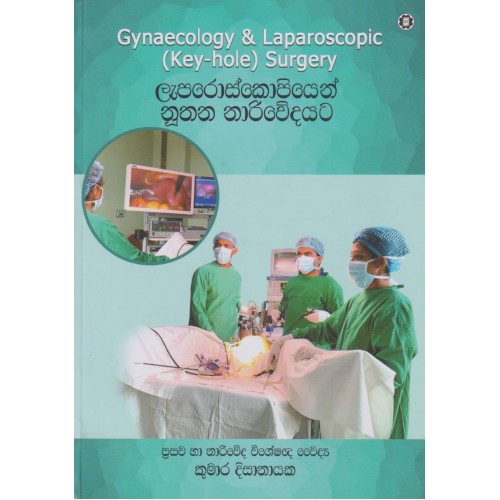
A Practical Guide to Gynecology
Dr. Kumara Dissanayake
Gynecology is the study of diseases affecting the uterus, ovaries and vagina. Throughout years of clinical practice, it became evident that reliable educational resources in Sinhala are limited. This publication was written to bridge that gap and help women, students and healthcare professionals gain a better understanding of gynecological diseases and related surgical treatments.
- MBBS
- MD (Obstetrics & Gynaecology)
- MRCOG (United Kingdom)
- Fellowship in Gynecological Endoscopy (India)
- Diploma in Advanced Gynae Laparoscopy (Germany)
- Member – BSGE & ISGE
- Head / Senior Lecturer
- Department of Obstetrics & Gynaecology
- Faculty of Medicine and Allied Sciences, Rajarata University
- Consultant Obstetrician & Gynaecologist
- Teaching Hospital Anuradhapura, Sri Lanka
Peer-Reviewed Publications
Intra Cervical Foley Catheter vs oral misoprostol for pre induction cervical ripening of postdated pregnancies
M Goonewardene, DMA Kumara, MH Ziard, B Bhabu
Sri Lanka Journal of Obstetrics and Gynaecology, Vol. 36, Issue 3 (1 December 2014).
Introduction
An intracervical Foley catheter is a common method of pre-induction cervical ripening in Sri Lanka. Low-dose oral misoprostol (25 μg two-hourly) has recently been recommended as a method for ripening the cervix and inducing labour.
Objective
To compare the effectiveness of an intracervical Foley catheter for 24 hours versus two doses of oral misoprostol 25 μg four hours apart in ripening the cervix before induction of labour in postdated pregnancies.
Methods
A randomised controlled trial of women with uncomplicated singleton pregnancies, cephalic presentation and an unfavourable cervix (modified Bishop Score below 6) at 40 weeks and 6 days. Using stratified (primip/multip) block randomisation, women received either two doses of oral misoprostol 25 μg four hours apart (n = 74) or an intracervical Foley catheter for 24 hours (n = 78). The next morning the modified Bishop Score was recorded by assessors blinded to the intervention. If the cervix was favourable, labour was induced with amniotomy and intravenous oxytocin, and the method of delivery and induction-to-delivery interval were recorded.
Key Findings
- Parity, mean age and mean pre-intervention modified Bishop Score were similar between the two groups, in both primigravidae and multigravidae.
- Significant increases in mean modified Bishop Score were observed (2.6 to 3.3; 95% CI 1.7 to 4.1; p < 0.001).
Evaluation of six commonly used formulae for sonographic estimation of fetal weight in a Sri Lankan population
DMA Kumara, Hemantha Perera
Sri Lanka Journal of Obstetrics and Gynaecology, Vol. 31, Issue 1, pp. 20–33 (15 September 2009). Ubiquity Press.
Objective
To compare six commonly used formulae (Shepard, Campbell, Hadlock I, II, III and IV) for estimating fetal weight in a Sri Lankan population.
Methods
A descriptive cross-sectional study at Ward 9, Sri Jayewardenepura General Hospital, Kotte, from October to December 2007, including 86 singleton pregnancies. Fetal biometry (biparietal diameter, head circumference, abdominal circumference and femur length) was measured by ultrasound on the day before planned delivery, and actual birth weight was recorded within 30 minutes of delivery. Estimated fetal weight from each formula was compared with actual birth weight using Pearson correlation and ROC analysis.
Key Findings
- Hadlock IV showed the strongest correlation with actual birth weight (r = 0.836) and the largest area under the ROC curve (0.849).
- For babies under 2.5 kg, Hadlock IV had the highest sensitivity (75%); all formulae had high specificity (93.6% to 100%).
- For babies over 3.5 kg, Shepard had the highest sensitivity (90%), while Hadlock I offered the best balance (sensitivity 80%, specificity 89.5%).