Learn what to expect when visiting the Emergency Department. Learn More
Chronic pelvic pain is one of the most frustrating problems in women’s health — a condition that can drag on for months or years without a clear explanation. It’s estimated to affect somewhere between 6% and 27% of women, and in many parts of the world there isn’t even reliable data on how common it really is. When standard blood tests, scans, and examinations come back clean, doctors are often left searching for less obvious explanations.
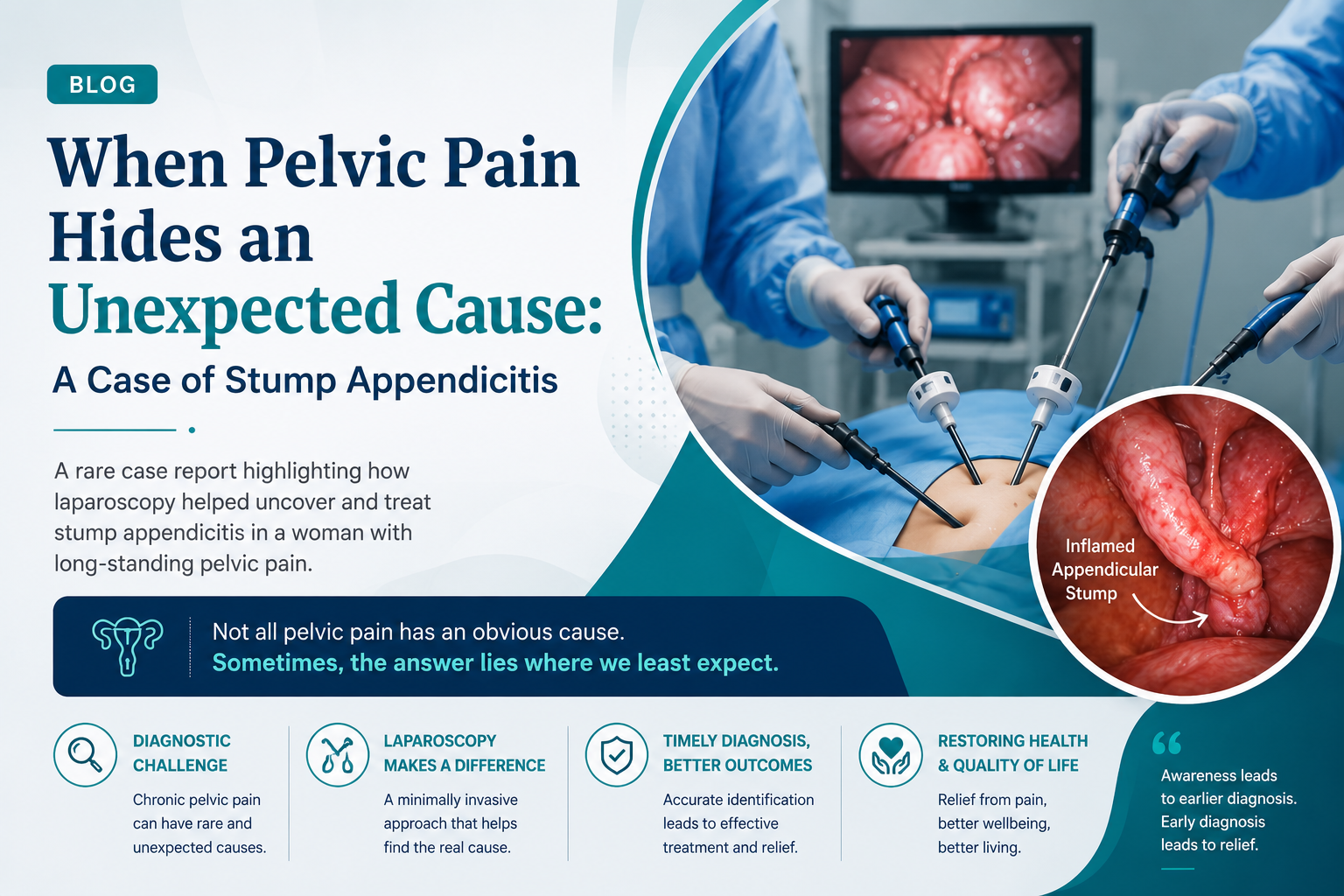
A recent case report from Rajarata University of Sri Lanka, published in the Sri Lanka Journal of Obstetrics and Gynaecology, highlights just how surprising the underlying cause can sometimes be — and how a relatively simple surgical tool, diagnostic laparoscopy, can crack cases that imaging alone cannot.
Chronic pelvic pain has a long list of possible culprits. Some are clearly gynaecological, such as endometriosis or long-standing pelvic infections. Others come from entirely different systems — the urinary tract, the gut, the muscles and nerves of the lower back and pelvis, or even psychological factors. This wide range of possibilities is exactly what makes the condition so hard to pin down.
One of the rarest possible causes is something called stump appendicitis: inflammation that develops in the small leftover piece of appendix tissue that can remain after an appendectomy. It’s thought to occur in roughly 1 in 50,000 people who have had their appendix removed, and it rarely crosses a gynaecologist’s mind as a possible explanation for pelvic pain. To make matters harder, routine ultrasound scans often fail to pick it up.
The report describes a 35-year-old woman who had been living with recurring, colicky pain on her lower right side for 15 months — pain severe enough to interfere with her farming work and family income. She had undergone an appendectomy two years earlier, followed by a second operation shortly after when she failed to recover fully; at that time, surgeons found and conservatively managed a leaking appendix stump. Her chronic pain began after that second surgery.
Blood tests, urine tests, and an ultrasound scan all came back normal. With CT and MRI scanners not readily available at the facility, and access to advanced imaging limited in many parts of the developing world, the medical team chose to proceed directly with diagnostic laparoscopy — a minimally invasive procedure that lets surgeons look inside the pelvis directly.
The laparoscopy revealed dense scar tissue binding the bowel and surrounding structures together, along with an inflamed mass in the lower right abdomen. After carefully separating the adhered tissue, the surgical team located a small, swollen residual piece of appendix — about 2 centimetres long — sitting quietly at the site of the original surgery. It was removed, and later confirmed under the microscope to be genuinely inflamed. The patient recovered well, with her pain resolving completely and a full return to normal activity within a month.
The case makes a broader point about how chronic pelvic pain should be worked up, especially in settings where high-tech imaging isn’t always within reach. Less than a fifth of the population in many developing regions has ready access to CT or MRI scanning, and patients can face long waiting lists even where it exists. Diagnostic laparoscopy, by contrast, is often more readily available — and studies cited in the report found it correctly identifies the cause of chronic pelvic pain in the vast majority of cases where it’s used, with one study reporting a diagnostic yield above 90%.
Laparoscopy isn’t risk-free — it carries a small chance of complications such as injury to the bladder, bowel, or blood vessels, though this risk is low in experienced hands. But when basic blood work and imaging come back inconclusive, the authors argue that moving to laparoscopy is often the more practical next step rather than waiting on advanced scans that may not be accessible anyway.
Chronic pelvic pain can be as frustrating for clinicians as it is distressing for patients, precisely because its causes span so many different specialties. This case is a reminder that even a rare, easily overlooked condition like stump appendicitis deserves a place on the differential — and that in a low-resource setting, a well-equipped laparoscopy unit can be just as valuable a diagnostic tool as a CT scanner, sometimes more so.
Source: Dissanayake DMAK, Jayaratne I. “The role of laparoscopy in gynaecological practice for diagnosis of stump appendicitis as a rare cause of chronic pelvic pain.” Sri Lanka Journal of Obstetrics and Gynaecology. 2021;43:194-196.