R
A
G
E
C
Every year, hundreds of thousands of women around the world die from pregnancy-related causes that could largely be prevented. As countries improve their medical care for mothers, a quieter but equally dangerous threat has emerged: maternal mental health problems, including depression, anxiety, and even suicide during and after pregnancy. In Sri Lanka, this issue is especially urgent — reanalysis of maternal deaths using international classification standards revealed that suicide has become the leading cause of maternal mortality in the country.
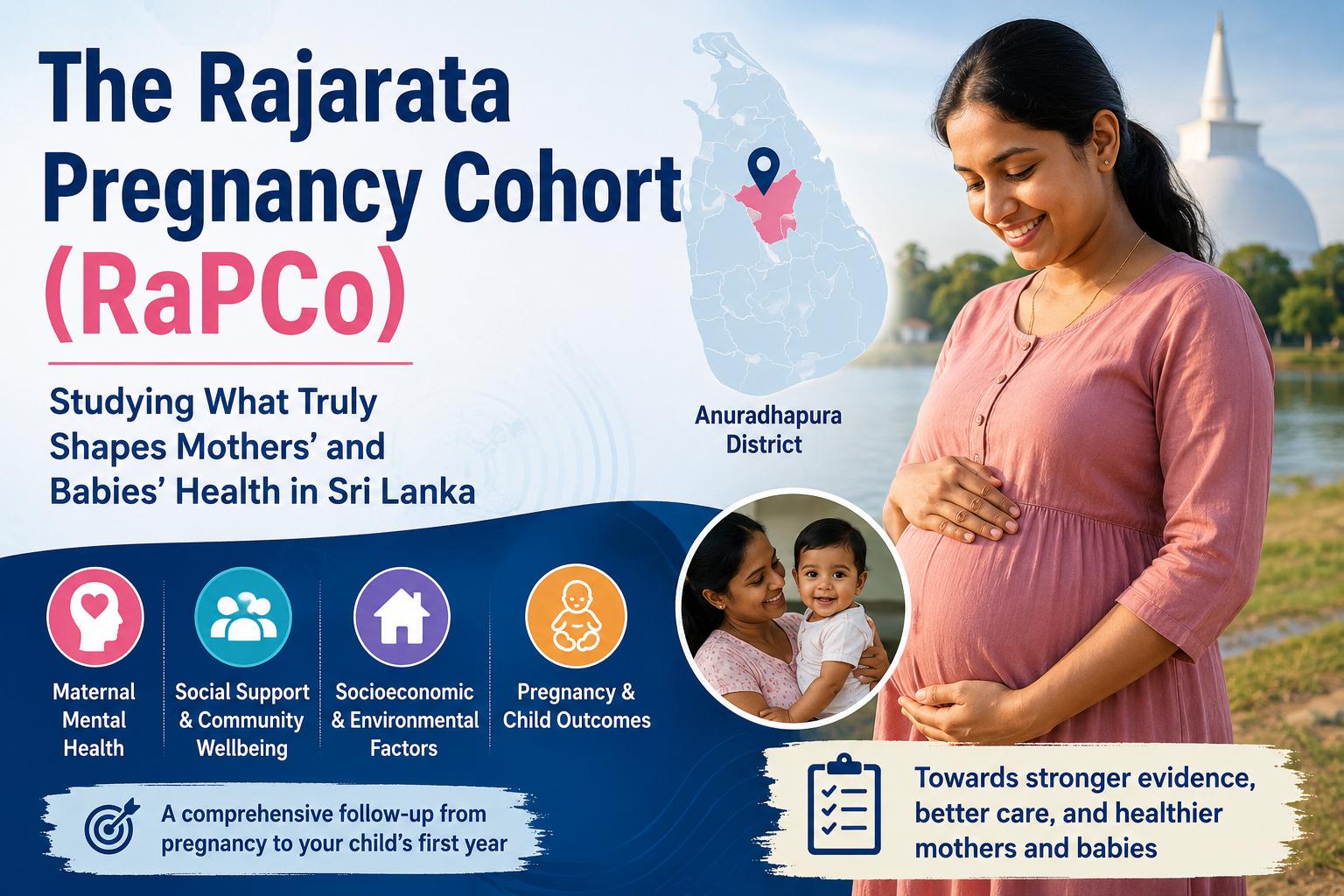
To address this gap, researchers from the Faculty of Medicine and Allied Sciences at Rajarata University of Sri Lanka launched the Rajarata Pregnancy Cohort (RaPCo) — the first large-scale, community-based study in the country to closely examine how social factors and mental wellbeing shape the outcomes of pregnancy and early childhood.
Why Social Factors Matter
Much of global maternal health policy focuses on clinical interventions — better hospitals, more skilled birth attendants, improved emergency care. While these are vital, they often overlook the social determinants that quietly shape a woman’s experience of pregnancy: her economic situation, the support she receives from family and community, exposure to gender-based violence, and her overall psychological wellbeing. The RaPCo study set out to fill this evidence gap by tracking these factors directly, rather than relying only on routinely collected health statistics.
How the Study Works
The study enrolled all eligible pregnant women registered in the public maternal health system across the Anuradhapura district — the largest district in Sri Lanka — during a three-month recruitment window in 2019, resulting in roughly 2,400 participants. Women were brought into the study in early pregnancy (before 12 weeks) and followed through several stages: the second and third trimesters, delivery, the postpartum period, and finally through their child’s first year of life.
At each stage, the research team gathered a rich mix of information, including:
- Socioeconomic background and living conditions
- Experiences of gender-based violence
- Mental health screening for depression, anxiety, and psychological distress
- Measures of social support and community connectedness
- Personality traits
- Nutrition and household food security
- Standard clinical measurements and blood tests
Where a mother was identified as being at risk — whether due to poor mental health scores, signs of abuse, or other concerns — she was referred through the existing public health system for appropriate follow-up and support, in line with routine care protocols already in place in Sri Lanka.
What the Researchers Hope to Learn
The study team designed RaPCo around a series of interconnected questions: Does poor social support or economic hardship increase the risk of depression and anxiety during pregnancy? Does maternal mental health influence outcomes such as low birth weight, premature delivery, or poor infant growth? Are there is a link between an abortion experience and later psychological distress? And are there specific geographic pockets within the district where these risks cluster, pointing to inequalities that need targeted attention?
By following the same women over time rather than taking a single snapshot, the researchers can trace cause-and-effect relationships far more confidently than earlier, one-time surveys allowed.
A Community-Driven Approach
What sets RaPCo apart is the extensive involvement of the community throughout its design. Over more than two years, the research team consulted pregnant women, public health midwives, and local health officials to shape the study’s priorities and materials, including the information booklets given to participants. A pregnant colleague was even included on the research team to review the protocol from a participant’s point of view. This groundwork reflects a growing recognition that maternal health research is done better — and more ethically — when it is developed together with the people it is meant to serve.
Looking Ahead
As the largest cohort of its kind in Sri Lanka, RaPCo is expected to generate insights well beyond its original scope. Related projects have already branched out to look at heart disease, anaemia, metabolic syndrome, and other health conditions in pregnancy, using the same participant base. The ultimate goal is to give policymakers and healthcare providers concrete, locally grounded evidence to strengthen how Sri Lanka — and other countries facing similar challenges — protect the mental and physical wellbeing of mothers and their children.
Source: Agampodi et al., “The Rajarata Pregnancy Cohort (RaPCo): study protocol,” BMC Pregnancy and Childbirth (2020) 20:374.